
Bilan Carbone® ITERG 2024 - Measuring for action
An approach in line with ITERG's environmental strategy
With its long-standing commitment to reducing its environmental footprint, ITERG has made the Bilan Carbone® a central tool for steering and continuous improvement.
Beyond measurement, this assessment makes it possible to identify priority action levers and support the low-carbon transition of its activities and those of the industries it supports.
A complete diagnosis of 2024 data
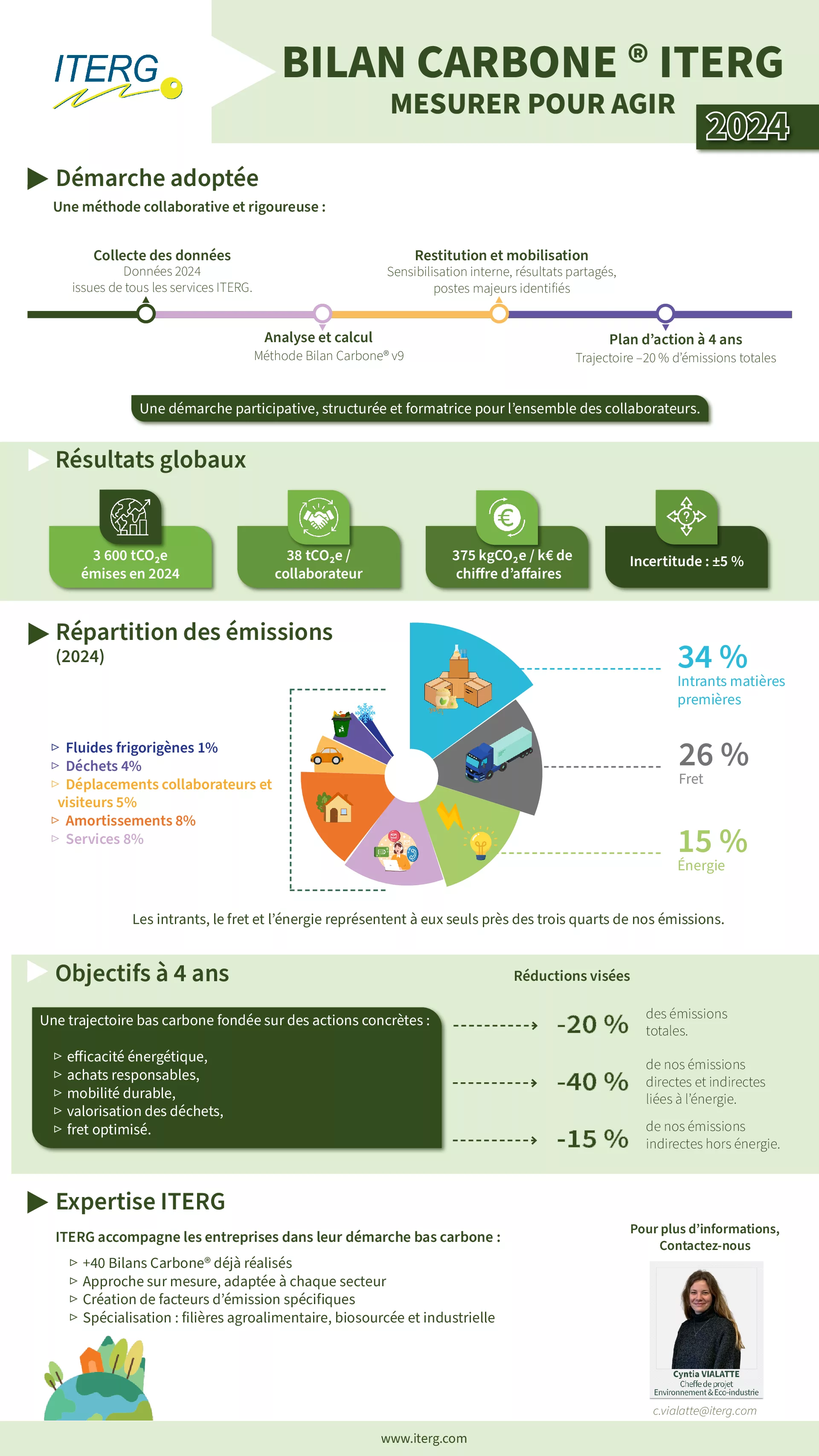
Carried out in 2025 on data from 2024, ITERG's Bilan Carbone® provides a precise statement of the emissions linked to its activities.
The results show a total of 3,600 tonnes CO₂ equivalent, or 38 tCO₂e per employee and 375 kgCO₂e per k€ of sales, with a low uncertainty (±5%).
Raw material inputs (34%) and freight (26%) are the two main sources of emissions, ahead of energy (15%) , business and visitor travel (5%) and waste (4%).
A rigorous, collective methodology
Conducted using the Bilan Carbone® v9 method, this work is based on a structured, collaborative approach.
Data were collected from all departments, consolidated and then analyzed to produce a global, shared view of emissions.
This analysis enabled us to identify the major items and build a 4-year action plan, aligned with a trajectory of -20% emissions by 2029.
An ambitious low-carbon trajectory
ITERG has defined concrete reduction targets:
-
-40% reduction in energy consumption,
-
-15% on other items,
-
for an overall reduction of -20% by 2029.
The plan is structured around five priorities: inputs, energy, travel, waste and freight.
It is accompanied by internal awareness-raising initiatives and ongoing reflection on daily practices and technical choices.
Expertise at the service of industries
In addition to its own assessment, ITERG makes its Bilan Carbone® experience available to economic players.
With over 40 assessments carried out, the Institute offers a tailor-made approach, adapted to the specific needs of the agri-food, bio-sourced and industrial sectors, including the creation of specific emission factors.
Measure, understand, act: ITERG continues its commitment to a sustainable low-carbon transition.

Cyntia VIALATTE
Project Manager
Environment and Eco-Design
Contact:
c.vialatte@iterg.com
Phone: (0)5 56 36 00 44