Bio-based estolides derived from metropolitan erucic acid: synthesis and performance
September 7, 2026
Oral presentation by Boris Bizet, Green Chemistry Project Manager at ITERG, at the ICBL-GERLI, September 21–24, 2026, Bordeaux - “Bio-based estolides from metropolitan erucic acid: synthesis and performance”
Climate change and environmental concerns are driving the search for more environmentally friendly products and solutions. In this context, the development of bio-based chemicals—which are less dependent on petroleum—has emerged as a viable alternative.
Specializing in the derivatization and functionalization of materials derived from vegetable oils, ITERG has been working for about a decade on the development of estolides, a specific family of polyester oligomers.
- Estolight Products
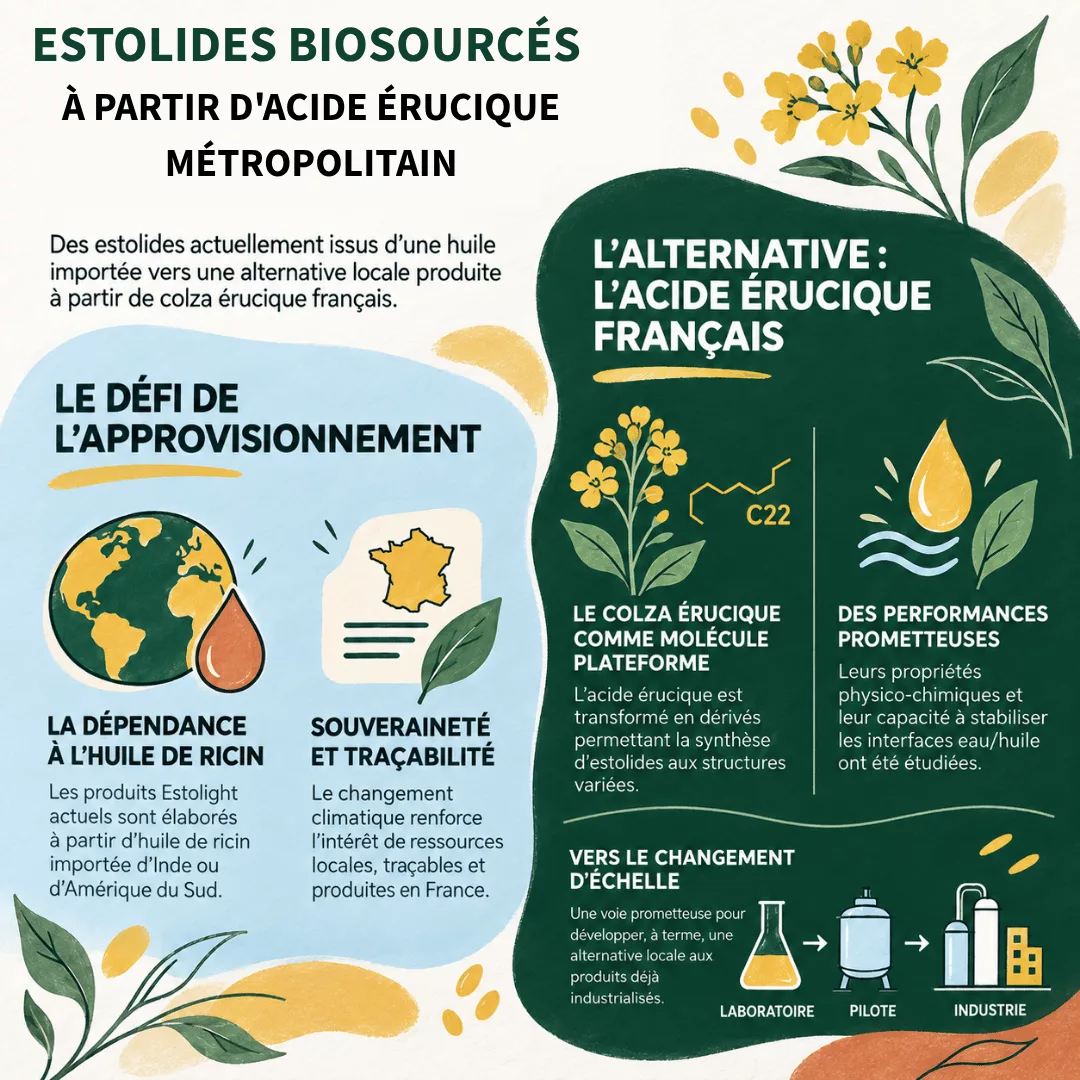
The Estolight-1E and Estolight-1AH products are bio-based estolides specifically designed to meet the needs of the cosmetics industry. Now produced on a “ ton ” scale, they have reached the industrialization stage and have become benchmark products. They have demonstrated promising performance in terms of dispersing fillers and filters, improving textures, and, more generally, enhancing sensory properties. However, they are derived from castor oil, an exotic oil sourced from India or South America.
- Search for another source
The search for a local source—produced in France—that offers better traceability and performance that is at least equivalent is therefore of major interest. Non-food-grade erucic rapeseed oil, and more specifically the erucic acid derived from it, appears to be a promising candidate. This 22-carbon fatty acid, containing one double bond, can be used as a platform molecule and converted to yield C22 monohydroxylated saturated compounds, which are analogs of 12-hydroxystearic acid derivatives.
The free fatty acids and methyl esters obtained in this way were then used in polycondensation reactions to produce erucic acid-based estolides with various structures, including amphiphilic ones. Their performance was then evaluated in terms of their physicochemical properties and their use as stabilizers at water/oil interfaces.