
Presentation at the Journées Chevreul, November 12, 2026 – Alejandro Jimenez, Patrick Carré, Jean-Philippe Loison
Background:Rapeseed meal (RSM) is less highly valued than soybean meal (SBM), in part because fiber dilutes its protein and amino acid content, and because conventional processing methods reduce lysine availability. RSM contains 73% of the protein content of SBM, but only 53–56% of the ileal-digestible (normalized) lysine content for pigs and poultry. Improving protein concentration and digestibility could therefore increase the nutritional value of locally produced oilseed meal .
Objective of the study: This study aimed to determine whether dehulling, combined with intensified mechanical oil extraction, could improve the nutritional value of rapeseed meal without resorting to solvent extraction, while reducing carbon emissions associated with processing.
Methodology: Rapeseed and sunflower seeds were processed using a decortication, cold pressing, extrusion, and pressing (DCXP) method. Decortication removed the fiber-rich hulls. After cold pressing, extrusion increased the oil content prior to a second pressing. Oil yield, the composition of the “ meal,” energy balances, and zootechnical value were evaluated in comparison with conventional reference “ meal ” and processes.
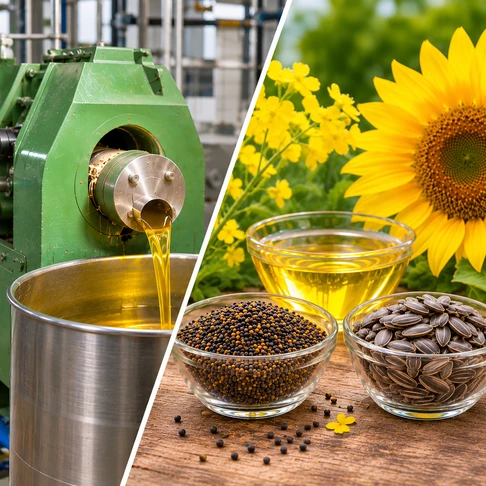
Key findings highlighting the study's strengths: DCXP rapeseed meal contained 43.5% protein, less than 6% residual fat, and 6.9% crude fiber. Compared to conventional rapeseed meal (RSM), the normalized ileal digestible lysine content increased from 13.7 to 23.7 g/kg in pigs and from 14.1 to 23.6 g/kg in poultry, reaching 92 to 93% of the values for soybean meal (SBM). The apparent metabolizable energy for poultry increased from 1,450 to 2,161 kcal/kg, approaching the value of soybean meal (SBM) at 2,260 kcal/kg. Estimated energy-related carbon emissions decreased from 77 to 27 kg of CO₂ per ton s of processed rapeseed and from 80 to 28 kg of CO₂ per ton s of processed sunflower, which is approximately 65% less than conventional benchmarks.
Conclusions and Outlook: The DCXP process combines deep mechanical de-oiling with protein enrichment and improved lysine availability. It offers a viable, solvent-free method for producing higher-value-added oilseed- meal , while reducing the carbon footprint associated with the energy consumption of crushing. Further research should help optimize operating conditions, upscaling, and economic performance.
References
Danel, J., Pampouille, E., Gouyo, T., Vilariño, M., & Carré, P. (2024). Toward Protein Self-Sufficiency in Broiler Feeding: How Can the Utilization of Rapeseed and Sunflower meal s Be Improved? In Proceedings of the 15th Conference on Poultry and Foie Gras Waterfowl Research, Tours, March 20–21, 2024. ITAVI
Danel, J., Carré, P., de la Borde, I., and Vilariño, M. (2026). Nutritional value of expeller-type rapeseed and sunfl meal , and dehulled fava beans in fast- and slow-growing chicken breeds. In Proceedings of the 16th Conference on Poultry and Foie Gras Waterfowl Research, Tours, March 18–19, 2024. ITAVI
Funding
The Cap Protéines and Cap Protéines+ programs received financial support from the French Ministry of Agriculture, under the “France Relance” recovery plan and the ecological planning framework, respectively.