
3-MCPD: A New Study Sheds Light on the Fate of These Contaminants in the Body
September 1, 2026
3-MCPD (3-monochloropropane-1,2-diol) esters are process contaminants that may form during food processing, particularly during high-temperature stages of vegetable oil refining.
Controlling these substances is a major challenge for the food industry, in a regulatory environment that continues to evolve. Regulation (EU) 2023/915 sets maximum levels for 3-MCPD and its esters in various categories of foodstuffs. It was recently amended by Regulation (EU) 2026/1825, which updates the regulatory framework governing these contaminants in food.
In this context, a new study published in the scientific journal*Biochimie*shedslight on the fate of 3-MCPD diesters after ingestion—from their digestion to their distribution throughout the body and their accumulation in tissues.
- Research involving several scientific partners
This study was conducted with the participation of ITERG, Lipolytech, and Aix-Marseille University / CNRS – UMR 7281 Bioenergetics and Protein Engineering.
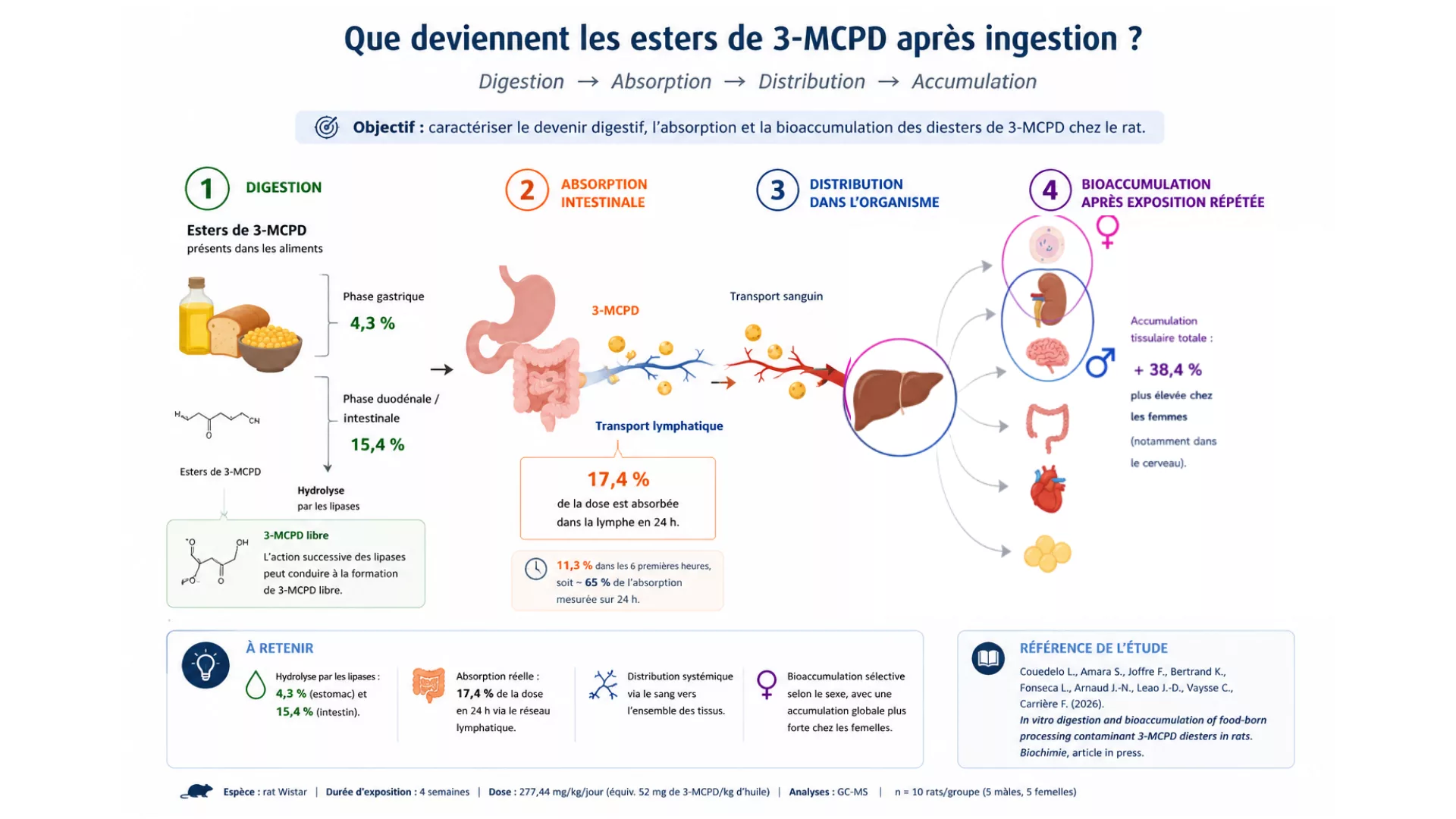
The researchers focused on three key stages: the hydrolysis of 3-MCPD esters during digestion, their absorption via the lymphatic system, and their distribution in various tissues following repeated exposure.
- Limited but effective digestive hydrolysis
The results show that 3-MCPD diesters can be hydrolyzed by gastric and pancreatic lipases.
In the digestion model used, the hydrolysis rate reached 4.34% at the end of the gastric phase and 15.38% after the duodenal phase. The successive action of digestive enzymes can thus lead to the formation of free 3-MCPD.
Hydrolysis therefore remains limited, but it is a critical step in the bioavailability of these contaminants.
- Absorption that continues within the body
The study then shows a cumulative lymphatic absorption of 17.4% over 24 hours. This absorption occurs primarily in the first few hours after ingestion: 11.3% is absorbed during the first six hours, representing approximately 65% of the absorption measured over 24 hours.
These results show that, despite relatively low levels of digestive hydrolysis, a fraction of the 3-MCPD esters can be absorbed and subsequently distributed throughout the body.
- Accumulation varies depending on tissue type and sex
After repeated exposure over 4.5 weeks in rats, 3-MCPD was detected in plasma and in all tissues studied. The highest concentrations were observed in the liver, gonads, kidneys, heart, and brain.
The study also reveals differences in distribution between males and females. Overall, the measured tissue uptake is 38.4% higher in females. However, this trend varies by organ: concentrations are notably higher in females in the gonads, kidneys, and heart, while they are higher in males in the brain and adipose tissue.
- Understand Better to Master Better
This research provides new insights into the fate of 3-MCPD esters in the body. It shows that limited digestive hydrolysis does not prevent their absorption, transport, and accumulation in certain tissues.
Against the backdrop of evolving regulatory requirements, these findings underscore the importance of continuing research to better understand exposure to these contaminants and to limit their formation during the refining and processing of edible oils.
- Scientific References
Authors: Couëdelo L., Amara S., Joffre F., Bertrand K., Fonseca L., Arnaud J.-N., Leao J.-D., Vaysse C., Carrière F.
In vitro digestion and bioaccumulation of 3-MCPD diesters, a food-borne processing contaminant, in rats. Biochimie, 2026, article in press.
Link to the online publication: In Vitro Digestion and Bioaccumulation of 3-MCPD Diesters—Food-Derived Processing Contaminants—in Rats - ScienceDirect