
EBT: A New Analytical Method for Monitoring the Quality of L-tryptophan
September 8, 2026
ITERG proposes a new method for analyzing 1,1'-ethylidene-bis-L-tryptophan (EBT), an impurity that may occur during the manufacture of L-tryptophan.
This analysis is intended primarily for manufacturers, suppliers, and users of L-tryptophan who wish to monitor the quality of their raw materials and ensure the safety of their finished products.
Which products are affected?
L-tryptophan is an essential amino acid that occurs naturally in many protein-rich foods. However, EBT regulations primarily apply to industrially produced L-tryptophan—particularly that produced by fermentation—as well as to products in which it is used as an ingredient.
The analysis developed by ITERG focuses in particular on:
- L-tryptophan raw materials and powders;
- dietary supplements containing L-tryptophan;
- nutritional preparations enriched with L-tryptophan;
- pharmaceutical products or ingredients used in their manufacture;
- nutritional additives based on L-tryptophan intended for animal feed.
It thus makes it possible to test L-tryptophan as an ingredient before it is added, as well as to verify the quality of products that contain it.
A contaminant that has been monitored since the late 1980s
EBT attracted particular interest following the outbreak of eosinophilia-myalgia syndrome (EMS), which occurred primarily in the United States in the late 1980s.
This serious illness, characterized in particular by severe muscle pain and an abnormal increase in certain white blood cells called eosinophils, had been linked to the consumption of dietary supplements containing L-tryptophan from contaminated batches.
EBT is now subject to specific testing requirements in several quality standards. In particular, it is listed as an “impurity A” in Monograph 1272 of the European Pharmacopoeia, which sets a limit of 10 mg/kg.
A robust and sensitive method developed by ITERG
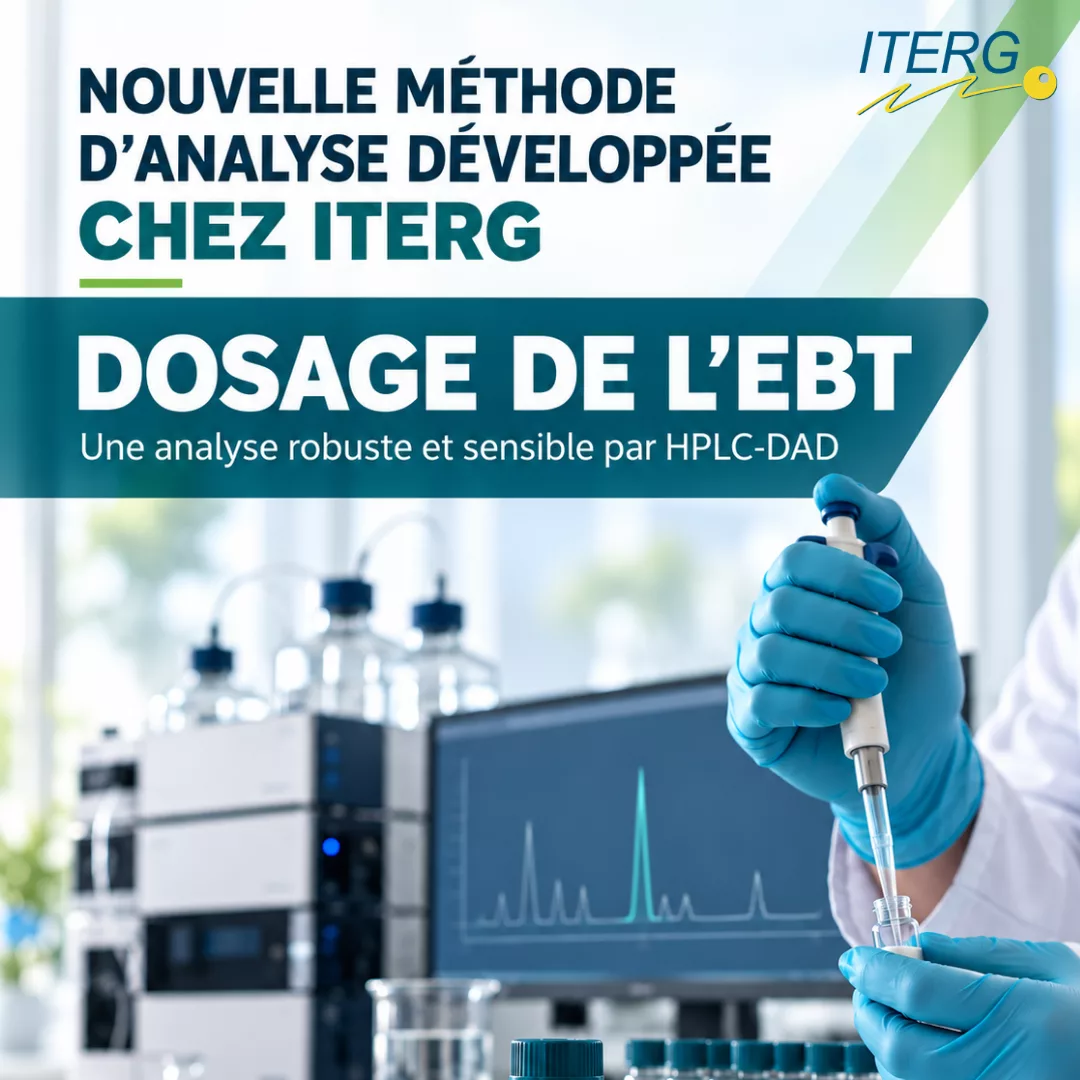
The method developed by ITERG is based on high-performance liquid chromatography with diode array detection (HPLC-DAD) and quantification by external calibration.
Its validation was performed using cross-validation and spiked samples to ensure the reliability of EBT detection and quantification.
Characteristics of the Method
- analytical technique: HPLC-DAD;
- quantification by external calibration;
- validation through cross-validation and quantified additions;
- measuring range: 2.5 to 80.0 mg/kg;
- Limit set by the European Pharmacopoeia: 10 mg/kg.
Securing Raw Materials and Finished Products
This new analytical method provides manufacturers with a robust and sensitive technique for detecting and quantifying EBT at trace levels.
In particular, it helps to:
- verify the purity of the L-tryptophan used as a raw material;
- verify its compliance with the requirements of the European Pharmacopoeia;
- select and inspect shipments from suppliers;
- improve control over manufacturing processes;
- make formulations containing L-tryptophan safer;
- ensure the quality and safety of finished products.
Drawing on its expertise in analytical chemistry, ITERG assists manufacturers in monitoring their raw materials and implementing analytical strategies tailored to their quality, compliance, and safety requirements.
Would you like to test for EBT in a raw material or product containing L-tryptophan?
Contact the ITERG team to discuss your needs.