
VALOPROP: An Innovative Approach to Structuring the Sorghum Industry and Accelerating the Sustainable Bioeconomy
Summary
Given the climate and demographic outlook—with the global population expected to reach 9 billion by 2050—the cultivation of species adapted to global warming has become urgent.
Sorghum, a gluten-free grain that is particularly well-suited to water and heat stress, meets this requirement and is a promising crop in terms of its content of biomolecules (proteins, fiber, carbohydrates, and polyphenols).
Sorghum grain is used for animal feed (60%) and human consumption (20%), as well as for biofuel production (20%). Its use in ethanol production generates distillers' grains, which are currently underutilized.
Processing them using eco-friendly and economically viable methods would help establish the sorghum industry in France and expand its potential for value-added use.
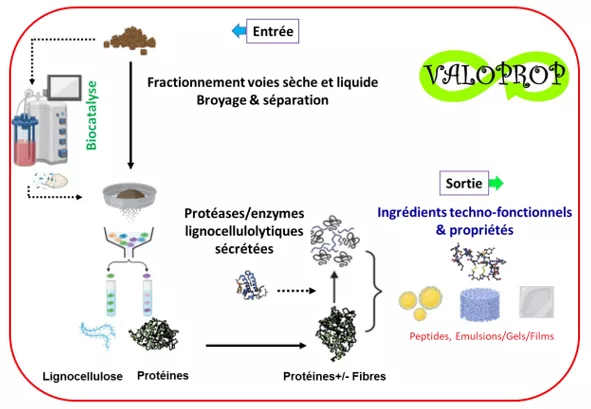
The VALOPROP project aims to valorize sorghum distillers' grains byproducing fractions with varying protein content and fractions rich in lignocellulose, as well as natural peptides, and to position these materials for functional (stabilizing) applications in the cosmetics and food industries.
He proposes to:
-
- Develop a cascade biorefinery process combining microbial fermentation with dry/wet fractionation to produce protein-rich and/or functional fiber-rich ingredients that are not yet available on the market
-
- characterize and optimize the functionalities of the fractions—emulsion stabilization, gel formation, and functional peptides—using a reactor mill developed atUMR IATE.
Objective: To develop new high-value-added ingredients for the food and cosmetics industries, particularly as stabilizers.
Renewal 3BCAR.
Contact: g.chollet@iterg.com