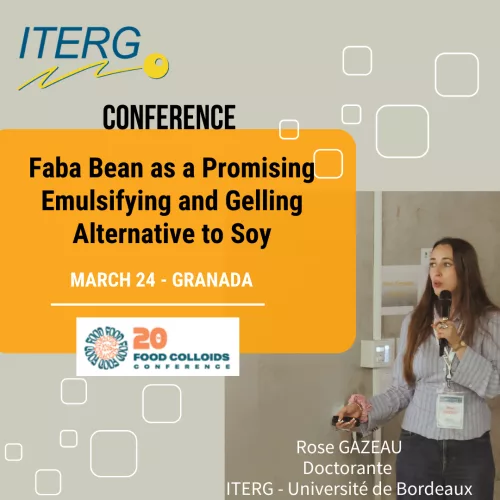
The broad bean: a promising alternative to soy as an emulsifier and gelling agent

The 20th Food Colloids Conference will take place from March 22 to 26, 2026, in Granada.

Rose Gazeau, a doctoral student at the University of Bordeaux/ITERG, will speak at the session titled “Alternative, Plant-Based, Clean-Label, Sustainable Food Colloids” with a presentation entitled: “Faba Bean as a Promising Emulsifying and Gelling Alternative to Soy.”

SUMMARY OF THE INTERVENTION

For several years now, consumer demand has been growing for minimally processed foods that have a reduced environmental impact and are free of artificial chemical ingredients [1]. One potential solution to this challenge is the use of plant proteins, which are known for their stabilizing and gelling properties [2]. However, the complexity of these systems makes them difficult to control and remains a major obstacle to their integration into food formulations.


Among protein-rich plants, soybeans have been the most extensively studied. Their high water solubility, along with their emulsifying and gelling properties, make them an attractive candidate for the food industry. However, their high content of isoflavones—classified as endocrine disruptors—poses a risk if consumed in excess [3]. Although less studied, the faba bean shows great potential. It can be grown in many regions of the world, including China, several European countries, Australia, and Ethiopia, and its cold tolerance allows for local production, limiting environmental impact. Furthermore, it offers significant nutritional benefits that contribute to a healthy diet [4]. Despite its lack of recognition, its physicochemical properties make it a very promising candidate for innovative food applications.


biotechnological biomass oils - Didier
The objective of this project is to understand the emulsifying and gelling properties of plant proteins and to relate them to their composition, production process, and physicochemical environment in simple systems. The ultimate goal is to apply this knowledge to more complex systems, such as dairy-type food models. A fava bean protein isolate and a soy protein isolate, with equivalent protein contents, were studied. Although both are capable of forming stable, well-structured emulsions and gels, their soluble protein contents differ. The soy protein isolate, which contains a higher proportion of soluble proteins, appears to be stabilized primarily by this soluble phase. In contrast, the fava bean protein isolate appears to be stabilized in a more balanced manner by both the soluble and insoluble fractions. The gelation mechanism also appears to be influenced by the relative contributions of these two fractions.


To investigate this, particular attention was paid to the role of these two fractions. The water solubility of the isolates was analyzed, as was the ability of the different plant protein fractions to reduce interfacial tension and form stable emulsions. Gel-forming ability and the associated mechanism were then studied using rheological measurements.

References:

[1] Hinderink EBA, Boire A, Renard D, Riaublanc A, Sagis LMC, Schroën K, et al. 2021. Combining plant and dairy proteins
in food colloid design. Current Opinion in Colloid & Interface Science.
[2] Etzbach L, Wohlt D, Susianto C, Dicke F, Pflügner P, Küllmer F, et al. 2025 Beyond the sum of parts: Exploring the
combination of plant protein ingredients for enhanced nutritional quality and techno-functionality. Food Chemistry.
[3] Martin AH, Nieuwland M, de Jong GAH. 2014 Characterization of Heat-Set Gels from RuBisCO in Comparison to Those
from Other Proteins. J Agric Food Chem.
[4] Bowland EL, Foegeding EA, Hamann DD. 1995 Rheological analysis of anion-induced matrix transformations in thermally
induced whey protein isolate gels. Food Hydrocolloids.
[5] Andlinger DJ, Bornkeßel AC, Jung I, Schroeter B, Smirnova I, Kulozik U. 2021 Microstructures of potato protein hydrogels
and aerogels produced by thermal crosslinking and supercritical drying. Food Hydrocolloids.
[6] Tanger C, Müller M, Andlinger D, Kulozik U. 2022 Influence of pH and ionic strength on the thermal gelation behavior of pea protein. Food Hydrocolloids

Contact: r.gazeau@iterg.com