
New amphiphilic structures derived from vegetable oils: evaluation of their properties and potential applications
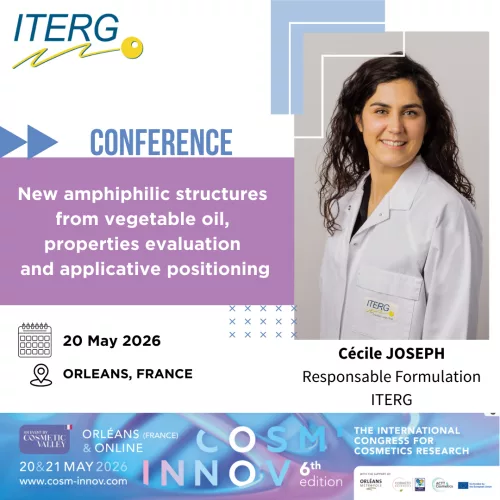
The 6th edition of the Cosm'Innov Conference will take place on May 20 and 21, 2026, in Orléans.
Cécile Joseph, a Formulation Development Engineer at ITERG, will give an oral presentation on "New amphiphilic structures derived from vegetable oil: evaluation of properties and potential applications."
SUMMARY OF THE PRESENTATION
Regardless of synthesis constraints, the process parameters for functional evaluation and application positioning require a structured and integrated approach. Stability and instability phenomena are complex and depend on the state of aggregation, adsorption and/or repulsion mechanisms between the emulsifier and the droplet, as well as formulation parameters such as water/oil/molecule ratios and the emulsification process.
The most promising molecules, selected using this method, were incorporated into simple yet representative prototype products (pigmented lotion, anhydrous balm, cream) to evaluate their stabilizing, dispersing, and emollient properties through physicochemical and sensory analyses.
They performed on par with commercial benchmarks under similar conditions of use, while offering an interesting range of sensory nuances.
Contact: c.joseph@iterg.com